
The Lead Time Penalty
Uncovering the Hidden Cost of Fulfillment Delays
Overview
In the race to maintain healthy margins, most supply chain leaders focus on carrier rates and fuel surcharges. However, some of the most aggressive profit leaks aren't found in shipping contracts—they are hidden in the gap between the warehouse floor and the loading dock.
In this case study, we explore how Autonomous Discovery by BizQuery helped Sarah, a Regional Director, uncover the "Lead Time Penalty": a direct correlation between internal fulfillment delays and explosive shipping cost variances.
1. Moving Beyond Siloed Data
Sarah knew her shipping costs were trending high, but her standard logistics reports only showed the final shipping bill. To find the root cause, she needed to bridge the gap between her Sales CRM (when the order was placed) and her Shipping Logs (when the product actually moved).
Instead of manual data merging and complex VLOOKUPs, she used a diagnostic discovery prompt to identify operational friction:
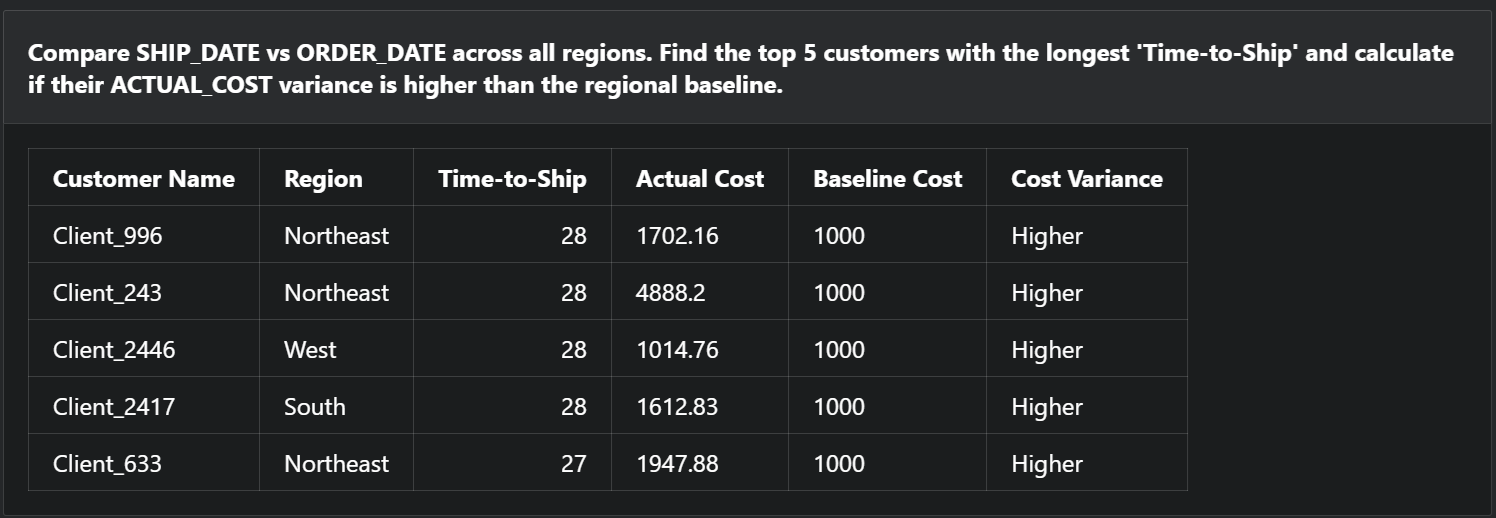
The Discovery Prompt: "Compare SHIP_DATE vs ORDER_DATE across all regions. Find the top 5 customers with the longest 'Time-to-Ship' and calculate if their ACTUAL_COST variance is higher than the regional baseline.".
2. The Discovery: Tracking the 28-Day "Profit Leak"
By autonomously bridging these data sources, BizQuery identified a systemic operational failure. The engine calculated the "Time-to-Ship" (Lead Time) for every order and cross-referenced it against the $1,000 regional cost baseline.
The Critical Correlation
The analysis revealed that the top five most delayed accounts had a lead time of 27 to 28 days. More importantly, these delays triggered a consistent spike in fulfillment costs.
3. Root Cause: Delay-Induced Expediting"
The autonomous discovery logic identified a clear pattern: when an order sits in the warehouse for nearly a month, it is no longer shipped via standard, cost-effective methods. To appease frustrated customers or meet month-end deadlines, these orders are often upgraded to "Expedited" or "Next Day" shipping.
The result? A 28-day internal delay effectively doubled (or in the case of Client_243, nearly quintupled) the shipping cost, turning a profitable order into a margin-negative transaction.
4. Strategic Impact: Operational Recovery
By using Root Cause Analysis, Sarah was able to move the conversation from "Shipping is too expensive" to "Our warehouse processing speed is driving expediting costs."
- Eliminated Data Blind Spots: BizQuery bridged the ORDER_DATE from the CRM with the SHIP_DATE from logistics, revealing a metric (Lead Time) that didn't exist in either file alone.
- Quantified the Inefficiency: Sarah could now prove that a 28-day delay costs the company hundreds, if not thousands, of extra dollars per order in unplanned logistics spend.
- Targeted Warehouse Fixes: Rather than renegotiating carrier rates, Sarah prioritized clearing the 4-week fulfillment backlog, which naturally brought shipping costs back toward the $1,000 baseline.
Conclusion: Data Bridging for Profit
Sarah's discovery proves that fulfillment efficiency is a profit center. When you use Autonomous Discovery, you stop guessing where the money is going and start seeing the mathematical reality of your operations.
Ready to transform your operations? Start your journey with BizQuery today.